From zero to operational sustainability.
“Because we are pioneering this process, it’s on us to set standards high.””
- Laura Mamazza, BKV Senior Facilities Engineer
Operationally speaking, Barnett Zero celebrated its first birthday in late 2024. But it has taken more than a few baby steps toward BKV’s net-zero goals. At year’s end, the project had injected approximately 173,325 metric tons of CO2 since startup, achieving an average 97% uptime. This pioneering initiative, a partnership with ONEOK (formerly EnLink Midstream), establishes an important precedent for CCUS moving forward.
“Part of BKV’s strategy is to seek out companies already removing high concentrations of CO2 from their natural gas streams,” said Laura Mamazza, BKV Senior Facilities Engineer. “Instead of flaring or releasing that gas into the atmosphere, they can partner with us to divert and store that waste with this mutually beneficial solution.”
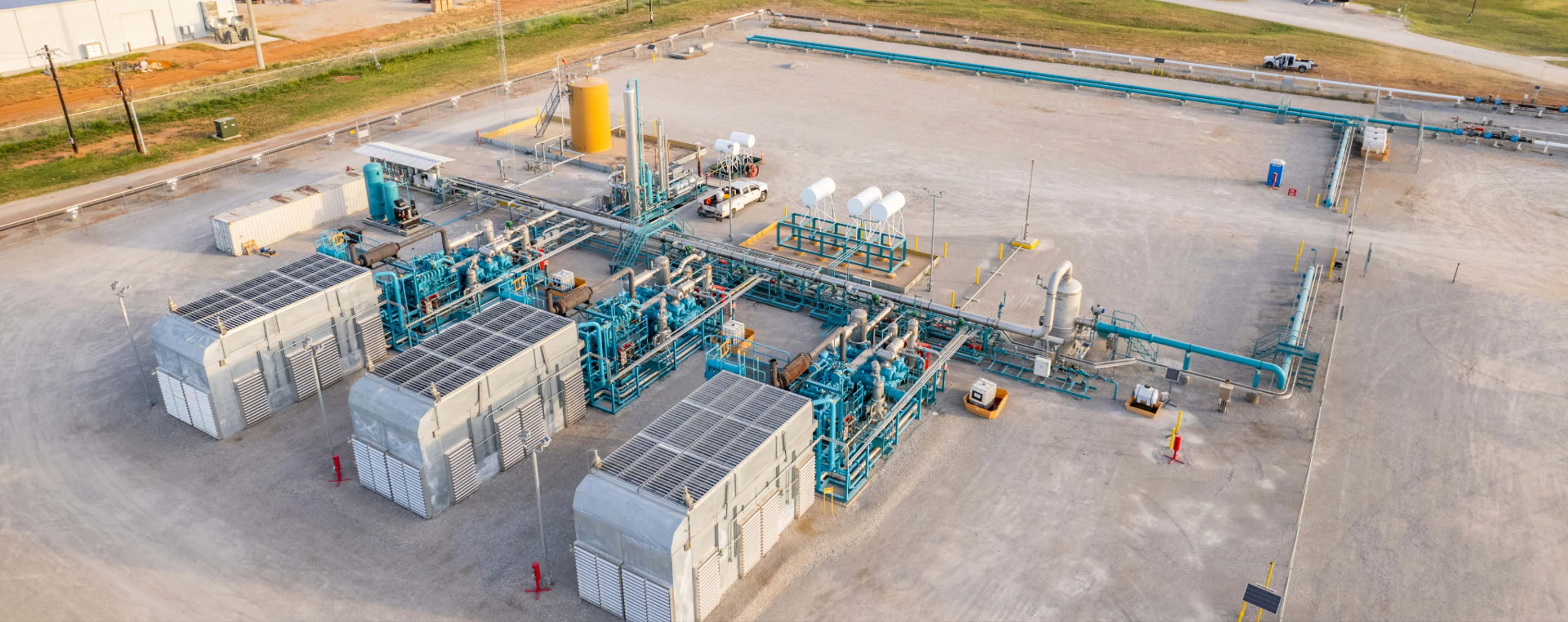
At ONEOK’s Bridgeport facility, installed blower systems facilitate the transport of CO2 generated during natural gas processing to BKV’s compressor station. There, pressure is increased from approximately 15 psi to 1,800 psi, converting CO2 into a supercritical state, with the density of liquid and the properties of gas. This high-pressure CO2 is then dehydrated to remove water, preventing corrosion and the formation of ice plugs during injection. Finally, the dry, supercritical CO2 is pushed down an injection well into an underground reservoir, safely and permanently sequestering it 9,000 feet beneath the ground surface, below traditional extraction depths.
“We go above and beyond,” said Mamazza, highlighting BKV’s protocols for ensuring transparency and compliance. “We have well monitors installed to continuously track downhole casing and surface pressures. We conduct pre- and post-project emission monitoring flyovers for comparisons. We inject tracer liquids into the CO2 stream to make sure it’s not migrating into other reservoirs. We monitor groundwater and seismicity. We monitor ambient CO2 levels around the compressor site for potential leaks. Because we are pioneering this process, it’s on us to set standards high.”
Barnett Zero is one of the first commercial, purpose-drilled Class II UIC wells in the U.S. for permanent underground sequestration of CO2 waste. This made BKV among the first companies in the U.S. to receive the enhanced Section 45Q tax credits provided for under the 2022 Inflation Reduction Act. Our partnership with ONEOK establishes the potential of cooperative CCUS models in the energy sector. It also demonstrates how integrating CCUS technology into existing natural gas operations can turn waste into a valuable resource, aligning economic and environmental goals.
As with anything new, there were some speed bumps early on. For example, during the first January of operations, a hard freeze created challenges right out of the gate, with ambient temperatures affecting system performance. But it also provided key learning opportunities for optimizing dehydration technology. At any rate, Barnett Zero quickly made up for lost time, achieving 99% uptime over the last six months of 2024. Lessons learned will be valuable moving forward with upcoming CCUS partnerships like Cotton Cove, BKV’s second CCUS venture in the Barnett Shale.
Barnett Zero has not only provided a blueprint for responsible energy production but also for thinking big, then making it happen. “I remember my first day with BKV. Chris Kalnin got up and asked, ‘Why aren’t we sequestering CO2 now?’” said Mamazza. “The technology already existed. He challenged us all to take tangible steps toward our net-zero goals. We’re not only doing it, we’re doing it the right way.”
Learn more about BKV's CCS initiatives here.